Young People in the Cultural and Creative Industries – Comparative Research and Feasibility Study (DigiCreate Project)
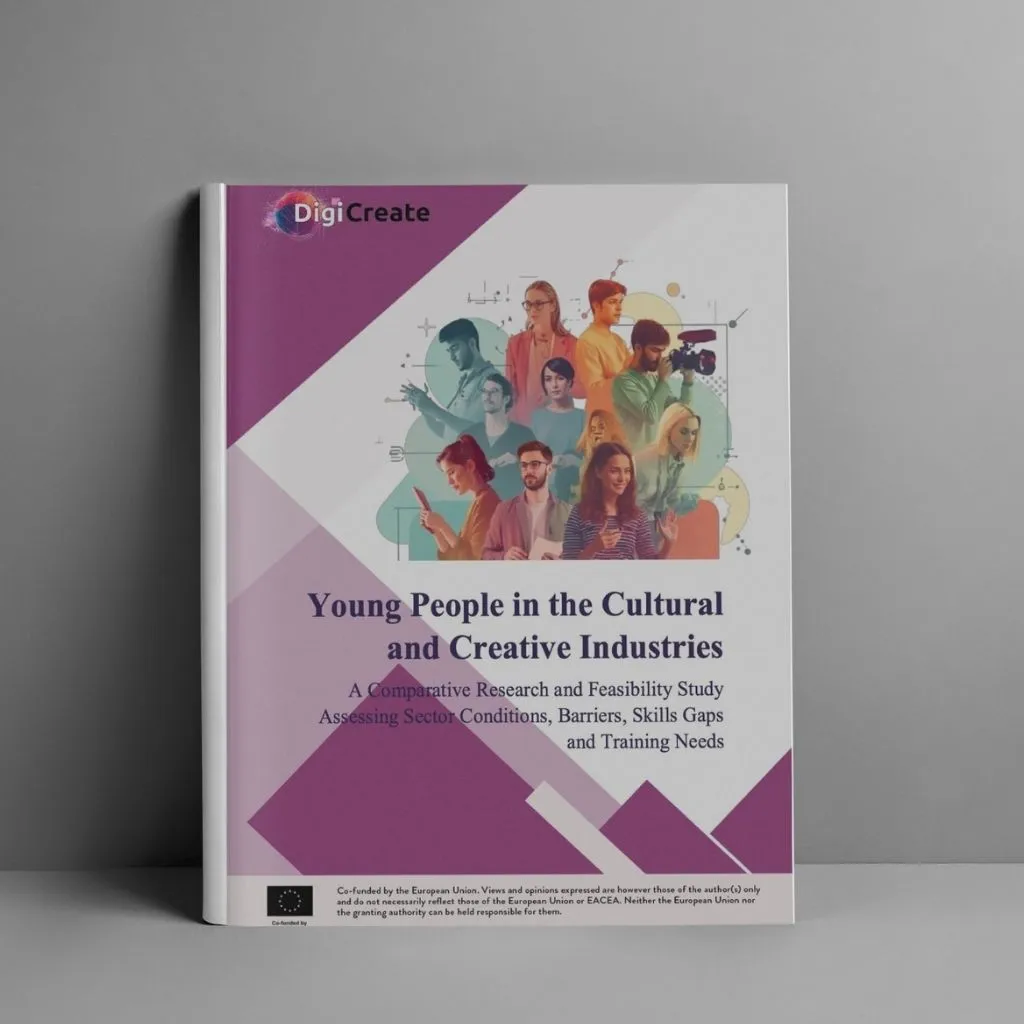
Within the DigiCreate project – Intercultural Digital Dialogue and Networking in Cultural and Creative Industries for Young People – partners have developed the publication “Young People in the Cultural and Creative Industries: A Comparative Research and Feasibility Study Assessing Sector Conditions, Barriers, Skills Gaps and Training Needs.”
This report represents a major milestone of Work Package 2 and provides the evidence-based foundation for the development of DigiCreate’s mentoring model, methodological framework, and digital learning activities.
Purpose of the research
The study explores the current realities of young people aged 18–30 working in, or aspiring to enter, the cultural and creative industries across six European and Western Balkan countries. Its goal is to better understand sector conditions, identify structural barriers, map skills gaps, and evaluate the feasibility of implementing a transnational digital mentoring and training framework.
By combining research findings from multiple countries, the report supports the creation of inclusive and practical solutions that respond to the real needs of young creatives and strengthen their opportunities for professional growth.
Research approach and scope
The report is based on a comprehensive mixed-methods research process, including:
Comparative desk research analysing policies, statistics, and sector trends in the creative industries
A large-scale online survey involving more than 700 young participants
Six national focus groups gathering qualitative insights from around 90 young creatives and youth stakeholders
A structured feasibility study assessing technical, financial, organisational, legal, and stakeholder factors influencing programme implementation
This multi-layered approach provides both statistical evidence and real-life perspectives, allowing the project to identify common regional challenges as well as country-specific needs.
Key findings
The research highlights that the cultural and creative industries across partner countries show strong growth potential, particularly in digital and hybrid creative fields. However, young people often face precarious employment conditions, freelance-based income instability, and limited access to structured career support or social protection.
Participants reported significant gaps in digital, entrepreneurial, and soft skills, including project management, financial literacy, communication, and intercultural collaboration. Many young creatives experience difficulties transitioning from education into sustainable employment and lack access to mentorship and professional networks.
At the same time, the study confirms strong interest in cross-border collaboration, flexible online learning opportunities, and practice-oriented mentoring programmes that combine digital tools with community-driven approaches.
Feasibility of the DigiCreate mentoring model
The feasibility analysis confirms that a virtual mentoring and training framework can be successfully implemented across partner countries, provided that digital accessibility, structured support systems, and inclusive design principles are ensured.
Hybrid and fully online learning formats are particularly valuable for overcoming geographic inequalities and enabling participation of young people who might otherwise face mobility or access barriers.
The study also evaluates organisational capacity, legal considerations, budgetary factors, timelines, and stakeholder engagement, ensuring that future DigiCreate activities are realistic, scalable, and sustainable.
Impact on the DigiCreate project
The findings of this report directly inform:
the development of DigiCreate’s methodological framework
the design of online training modules and mentoring programmes
the creation of the DigiCreate Digital Hive Toolbox and learning platform
the implementation of virtual exchanges and intercultural learning activities
By grounding all project outputs in solid research evidence, DigiCreate ensures that its activities respond to the lived experiences of young creatives and contribute to more inclusive and sustainable career pathways in the cultural and creative industries.
European partnership for youth empowerment
DigiCreate is implemented by a consortium of eight organisations from Germany, Spain, Portugal, Serbia, Montenegro, and Bosnia and Herzegovina, combining expertise in youth work, higher education, digital innovation, and creative industries.
Through research-driven methodology, digital tools, and international cooperation, the project supports young people in developing professional skills, building cross-border networks, and engaging in intercultural dialogue within the evolving creative economy.
Check it out on the link below
Co-funded by the European Union. Views and opinions expressed are however those of the author(s) only and do not necessarily reflect those of the European Union or the granting authority. Neither the European Union nor the granting authority can be held responsible for them.
SPIN IN SHORT
Our goal is to contribute to the development of a society with positive values, a society that is recognising the importance of critical thinking, healthy lifestyles and providing equal opportunities for all. Spin is dedicated to creating and providing equal opportunities for all.
LET’S CREATE TOGETHER
Have an idea that you want to turn into a project, have project you need help to implement, want to develop an online course?
Contact SPIN!
© Spin 2024 | Design by AMDesign